Screen Shot 2019-01-16 at 3.48.43 PM.png
 

Selected by Henri Cole for the 2018 Max Ritvo Poetry Prize

“The poetry of the earth is intensely alive in the poems of John James. In this luminous first book, there are poems of a son and a young father. Many of the best inhabit a tormented Kentucky landscape where there is a field with horses, a house and a barn, a flooding river, a cemetery where a parent lies, and bees or flies hovering. Out of the sorrowful fragments of personal history, John James has a created a book of unusual intelligence and beauty.”

—Henri Cole

“The titular poem in John James’s debut collection refers not only to the luminous hour of infant nurture, although that is its occasion, but to the violent loss of his father, an event distant enough that ‘snowmelt smoothes the stone cuts of his name.’ James’s searing attention is upon the fleeting, the untethered, upon fecundity and decay, the cosmic and the molecular. These are also the poems of a young father’s daily life in the wane of empire, who wishes ‘to remember things purely, to see them / As they are,’ and who recognizes in what he sees our peril. ‘The end,’ he writes, ‘we’re moving toward it.’ James is, then, a poet of our precarious moment, and The Milk Hours is his gift to us.”

—Carolyn Forché

“I can’t remember a collection of poems with a greater variety of trees in it than The Milk Hours, or one that has left me so conscious of the centrality of the tree to human history, or for that matter, to humanness itself—from the microscopic branches of our nerve endings to the vast tentacular dust lanes of the galaxy we live in. Impeccably constructed, profoundly felt, and every bit as gorgeous as it is full of powerful observation (a candlewick’s “braided cotton converting to amber,” dead stars that throw “cold light through the black matter / of millennia”), The Milk Hours is a startlingly mature, exhilarating debut, and one whose urgent evocation of the past and confident reaching for what lies ahead ensure it a prominent place in our present.”

—Timothy Donnelly

“‘Home is a question,’ writes John James in The Milk Hours, a remarkable debut in which sorrow leads to an astonishing intimacy with the world. The speaker is pensive but inquisitive, bewildered by the loss of a father and renewed by love and parenthood. Art, science, and travel, like mortality, become tethers to the elegant and chaotic truths of our world. The Milk Hours is a moving and urgently crafted testament to resilience and to beauty.”

—Eduardo C. Corral

Read poems from The Milk Hours

Read reviews in

Order The Milk Hours now through the following venues, or through your favorite local bookstore:

View press release


Winner of the Snowbound Chapbook Award

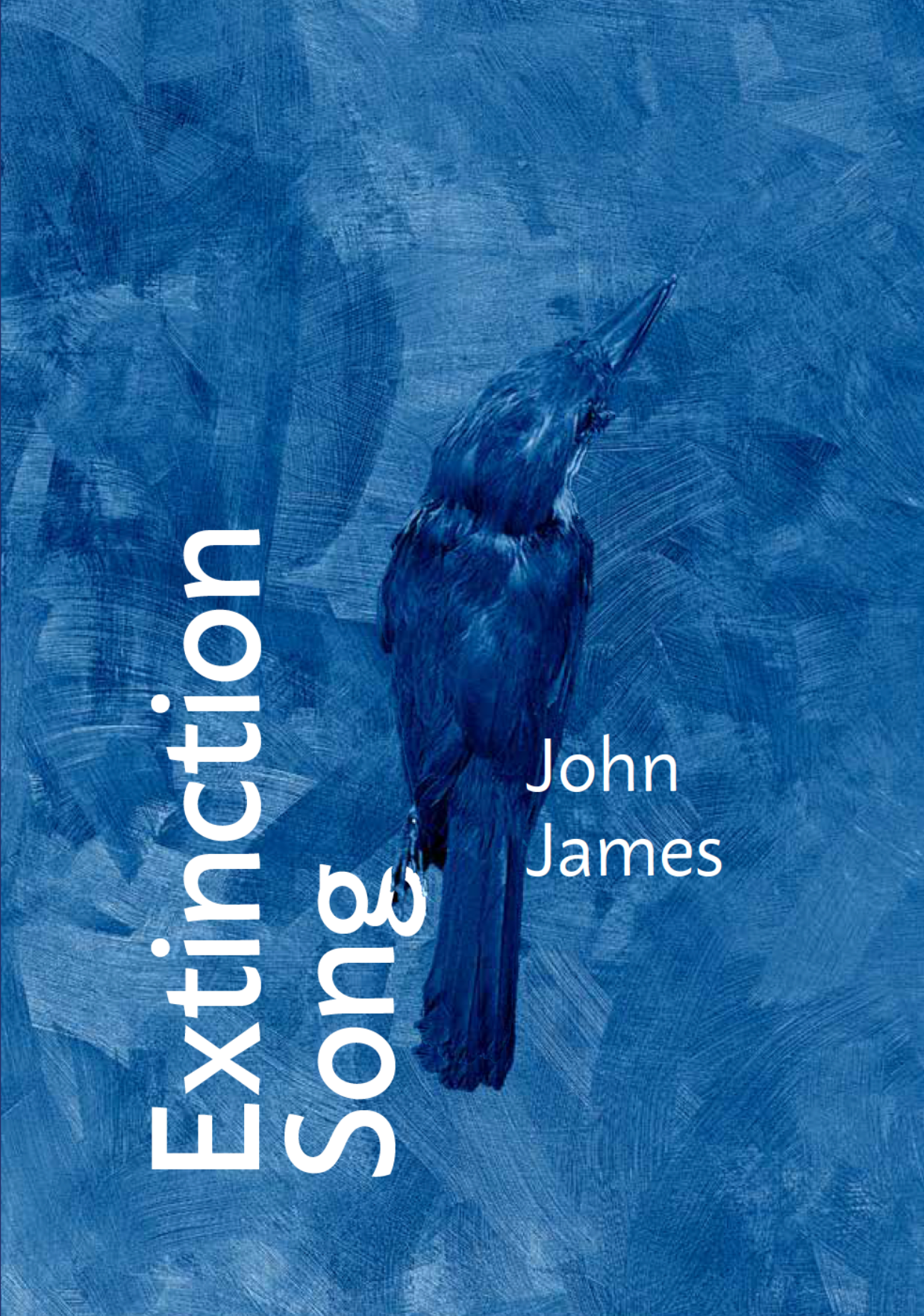
Extinction Song is a beautifully sustained and unified work, a mesmerizing and devastating meditation on time and impermanence, how this world changes us and is changed by us. The individual poems probe the spaces of our habitual double-think, the inconsistencies in our logic, as we persist and give birth to a new generation on a planet whose ecological future is in continually greater peril. As John James puts it in “Lullaby,” “I linger at the end, / the edge of it. I tread / the precipice / of the abyss.” This work gives shape to our shared experience at this particular catastrophic juncture in late-stage capitalism. Yet as much as there’s a sense of authentic urgency and emergency in these pages, Extinction Song is not overwrought or hysterical. What surprises me most about these poems is their delicate workmanship, evident in their rhythmic deftness and rich sonic textures, as well as in the attention they pay to language and formal architectures. Through their very poetics, in other words, they attend to this world, both its damages and its promises. In the marvelously specific and centering “Future Perfect,” the poet writes, “there is no Mars, no / plan B. No second-chance / planet to escape to. There is your foot /on the ground and the ground / beneath it. There is / the proof of the red / balloon.” This chapbook makes a good companion.”

—Monica Ferrell, Judge’s Citation

“The feeling and thinking in Extinction Song arise from the experience of fatherhood in a time of climate crisis. An immaculate craftsman, James has fashioned a prosody that holds in productive relation “the real and imminent,” the provocative fact that life “tends/in directions/almost infinite” even during the Sixth Extinction. Most intimate in their meticulousness, each syllable bearing his measured touch, these agile lines track the syntax of “thought as it motions/through the channels of the mind” until the experience of “feeling/thinking” comes alive with riveting immediacy. Calling upon the power of a visionary tradition that includes Gerard Manley Hopkins, Robert Duncan, and Inger Christensen, Extinction Song reveals the peril and terror within the way we love this world.”

 —Brian Teare

“John James’s Extinction Song is an organism, breathing and thrumming, bound together by sinuous lines, supple rhythms, meshing rhymes. James en-strangens language in poems that surge to life on the page, their sonic twists and flourishes practically overspilling the chapbook’s container. Reading this book rings with the thrill of encountering a new creature. In its grace and tenderness, Extinction Song does magnificent justice to the world it describes.”

—Claire Wahmanholm

Read poems from Extinction Song

Purchase Extinction Song through the following venues or at your local bookstore:


In poems as tautly constructed as they are trenchantly observed, Winter, Glossolalia probes the nature of language to depict the world from which it springs. Paired with humorous, often satirical images, this collection explores human ingenuity and creativity against the material resources of the given world, highlighting the possibilities and the limits of artistic making. In that sense, it is both a timely and enduring book, one that recalls Virgil’s Georgics as readily as it evokes the crisis of anthropogenic climate change.

"John James is a collage artist. He cuts and pastes, making neighbors of images across continents, across centuries."

—Jane Zwart, Tupelo Quarterly


"James is a poet of staggering lyricism, intricate without ever obscuring his intent."

Shelf Awareness

Read poems from Winter, Glossolalia:

Order Winter, Glossolalia through the following venues, or through your favorite local bookstore:

 
Screen+Shot+2018-11-19+at+1.11.20+AM.jpg
 

“In poetry of highest lyric order, music is its own mind. Such a mind doubts even as it believes, listens even as it sees. That mind forms on the page: what we read, it sings; and what it sings, we see. John James is writing such poems. I want to call them synesthesiac, so attuned are they to the ways in which the wonder of one sense trespasses into the working of another. But what all here interpenetrates is more than just sensory. He knows the heart is but a synesthesia of the mind; he knows the opposite holds just as true. He shows, poem by poem, that the immediacy of life’s moment—be it the domestic world of wife and child, be it the unspooling landscape, be it the literature of the past—reveals when pressed gently upon that entrance into the penetralium where behind time’s veils all that has been continues be-ing, and the intimate and the ancient, love nervous and word relict, twine together into these poems whose power is in making no claim toward the beauty they so abundantly reveal. He does as that first singer did, Caedmon, who sang because he was told he must do so—a song of praise, of animals and life, of land and blood and time. Such work is wholly personal and completely anonymous, embedded in the very life and limb whose limits it also astonishingly resists.”

—Dan Beachy-Quick


“A brilliant offering full of loss and intimacies, Chthonic is a chapbook that begs a closer look into the strange darkness of ourselves. Stark landscapes, a piercing exactitude, and a merciful wisdom fill this book that walks ‘a tripwire of grief.’ An unflinching observer, John James writes with a patient honesty and a lyric beauty that will leave you ringing.”

—Ada Limón


Chthonic is a rending of the earth, an exploration for the sake of understanding all the unarticulated motivators that lay just beneath the surface of consciousness. James’s poems dig deep as he asks us to join him at the edge of his excavations, to see what he’s unearthed, and we can’t help but look until we see it too.”

Portland Book Review

Read poems from Chthonic

Purchase Chthonic